How to Launch a SaaS MVP Without Overbuilding
A practical guide to scoping and shipping a SaaS MVP: name the riskiest assumption, pick one user and one job, keep the basics solid and learn from a small launch.
A minimum viable product, or MVP, is easy to misunderstand. It is not a poor-quality version of the final product, and it is not a feature list with the last few items crossed out. It is the smallest thing you can put in front of real users to learn whether your idea is worth building further.
That framing changes how you scope, what you build and how you judge success. This guide walks through it step by step.
Name your riskiest assumption
Every new product rests on assumptions. Some are about the problem (“this task is painful enough to pay to solve”), some about the solution (“people will accept this way of working”), some about feasibility (“we can build this reliably”) and some about the business (“customers will pay at a price that works”).
List yours, then ask which one, if wrong, would make everything else irrelevant. That is your riskiest assumption, and the purpose of the MVP is to test it as cheaply and quickly as possible.
Write it as a sentence you can prove or disprove: “Operations managers at small distribution companies will replace their weekly spreadsheet with a shared dashboard.” A good statement names a specific person, a specific behaviour and a result you can observe.
Choose one user and one job
The most common reason an MVP balloons is that it tries to serve everyone. Pick one type of user and one job they need done, and shape the product around that.
- One user: a role in a type of organisation, specific enough that you could find ten of them tomorrow.
- One job: the outcome they are trying to achieve, in their words.
- One path: the shortest route from signing up to completing that job and seeing the result.
Anything that does not serve that path is a candidate for later.
Cut scope with a clear method
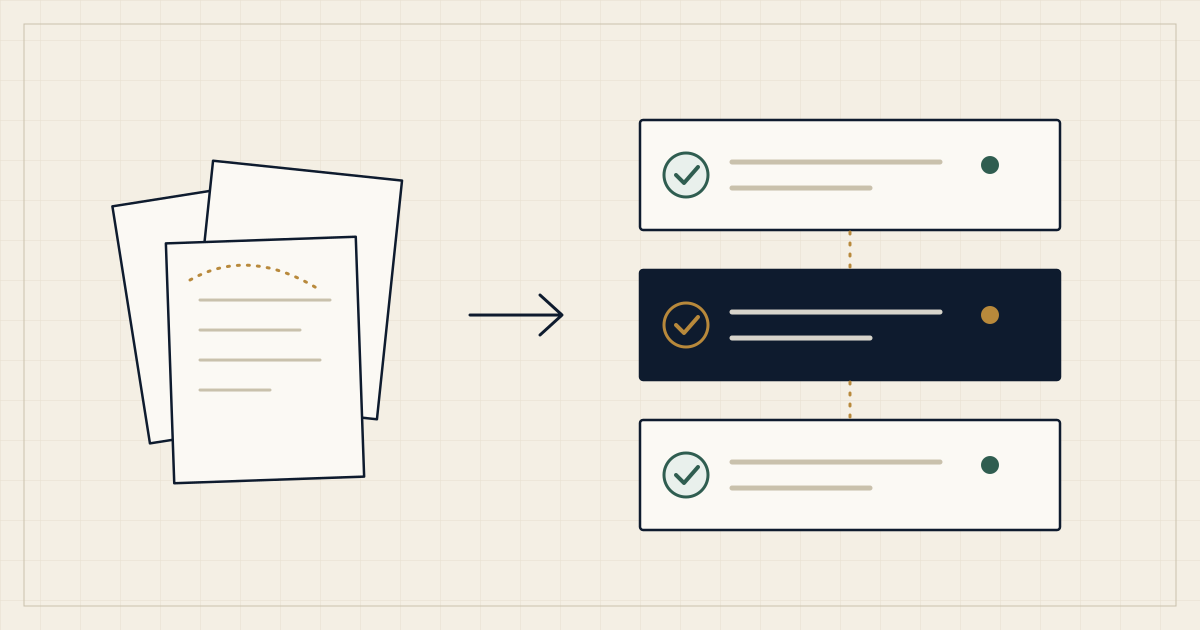
Make three lists.
- Must have: without these, a user cannot complete the job at all.
- Should have: these make the product pleasant or efficient but are not needed to test the assumption.
- Not now: everything else, written down so that nothing is lost and nobody has to argue for it again.
Then challenge the first list. For each item ask: could we do this manually for now? Could we use an existing product? Could the first users live without it for a few weeks?
Build a thin slice, end to end
Instead of building every layer completely, build one thin slice that works from start to finish: a user signs up, does the main job, and sees a result. It may be rough, with limited options and plain screens, but it is real and it exercises the whole system. This approach, sometimes called a walking skeleton, exposes integration problems early and gives you something to show users right away.
Consider doing parts by hand
Some of the best early learning comes from doing parts of the service manually behind a simple interface. A person might prepare reports that the software will eventually generate, or review requests that an automated rule will later handle. This lets you test whether customers value the outcome before you invest in automating it, and shows you what the automation would actually need to do.
Keep the technology boring
An MVP is the wrong place to experiment with unfamiliar technology for its own sake. Prefer tools your team knows well and that have a healthy community, so you can move quickly and find help.
Buy or reuse the commodity parts: authentication, payments, email delivery, file storage and hosting platforms exist so that you do not have to build them. Put your own effort into the part that is specific to your idea.
Foundations worth getting right
Minimum does not mean careless. A few foundations are much cheaper to include at the start than to retrofit later.
- Accounts and access: if your product serves organisations, decide early how accounts, users and roles relate, and how one customer’s data is kept apart from another’s. This is hard to change later.
- Security basics: secure authentication, protected secrets, encrypted connections, least-privilege access and regular dependency updates.
- Backups and recovery: know where your data lives, back it up and test that you can restore it.
- Error tracking and logging: you need to know when something breaks before your users tell you.
- Analytics events: instrument the key moments on your user’s path so that you can measure what you set out to test.
- Deployment pipeline: a repeatable way to build, test and release lets you ship small changes safely.
Do not let these grow into a long project. The aim is a sound base, not a perfect one.
Decide what success looks like before you launch
It is easy to see what you want in the results after the fact. Prevent that by writing down, before launch, what you will treat as evidence for and against your assumption.
- What behaviour would show that users find value? For example, completing the main job, then returning to do it again.
- How many users, roughly, do you need to hear from to feel informed?
- What would make you change direction, and what would make you continue?
Qualitative feedback matters as much as the numbers at this stage. Talk to your first users, watch them use the product if you can, and ask what they did before and what they would miss if it vanished.
Launch small and learn on purpose
- Start with a handful of users who match your target and are willing to give feedback.
- Make it easy to reach you, with a visible contact route and quick replies.
- Review what you learn on a regular rhythm, such as weekly, and update your assumption list.
- Change one important thing at a time so that you can tell what made the difference.
- Widen the audience gradually as the product and your confidence grow.
After the MVP
An MVP produces a decision. You may have confirmation to invest further, evidence that you should adjust the idea, or a clear signal to stop. All three are valuable outcomes, because they cost far less than discovering the same thing after building the full product.
If you continue, plan some time to strengthen the foundations: clean up shortcuts, improve test coverage, and revisit decisions made in a hurry. Technical debt is a normal part of early products, but it should be a conscious loan, not a surprise.
Common mistakes
- Adding features to compensate for not yet knowing who the product is for.
- Delaying launch until it feels ready, instead of until it can teach you something.
- Measuring sign-ups instead of whether people complete the job.
- Skipping the foundations that are hard to add later.
- Treating the MVP as a throwaway or as a finished product, instead of as the first step.
Talk it through
If you are shaping an MVP and want help with scoping, architecture or the first build, you are welcome to get in touch. A short description of the user, the job and the riskiest assumption is a good place to start.